

Battery technology is quickly becoming the backbone of renewable energy integration, electric vehicles, and portable electronics. As demand grows, the need for reliable, efficient, and rapid testing solutions has never been greater. Modern industries are moving beyond traditional assessment tools in favor of approaches that can unlock new performance benchmarks. Innovations range from advanced analytical methodologies to digital simulations and sustainable practices, with each addressing complex challenges in battery health evaluation. High-tech battery test chambers equipment plays a fundamental role in these advancements, enabling a new generation of precise and accelerated testing regimes that power global progress.
But these next-generation solutions go beyond convention, incorporating artificial intelligence, real-time data analysis, and sophisticated modeling techniques. This pivotal shift empowers researchers and manufacturers to identify potential failures before they occur, optimize battery lifecycles, and significantly reduce the time and resources required for evaluation. Achieving more sustainable and longer-lasting energy storage is a direct result of these converging innovations, making battery testing a critical component of technological progress and environmental stewardship.
Electrochemical Impedance Spectroscopy (EIS)
Electrochemical Impedance Spectroscopy (EIS) is revolutionizing how scientists and engineers assess the internal workings of batteries without causing damage or lengthy downtime. By introducing a range of sinusoidal electrical signals into the battery, EIS can probe the cell’s internal resistance, detect electrolyte degradation, and monitor charge-transfer efficiency, all of which are closely tied to real-world performance and safety. This diagnostic technique is especially powerful in quality assurance settings, where rapid screening is crucial for large-scale battery production, as found in electric vehicle factories and grid storage solutions. When paired with statistical modeling, EIS delivers comprehensive analysis within seconds, ensuring only the most robust batteries reach consumers and industries.
Machine Learning in Battery Testing
Battery development has entered a new era of speed and precision thanks to machine learning algorithms. These intelligent systems process vast datasets from thousands of previous tests, identifying subtle relationships between charging protocols, material choices, and test outcomes. One landmark advancement by a Stanford-led team demonstrated that machine learning can reduce battery test times from months to mere hours, expediting the innovation pipeline for safer, longer-lasting batteries. More importantly, these models can identify optimal performance configurations that were previously overlooked by human researchers—a crucial factor as engineers strive to enhance charge speeds and extend product lifespans.
As datasets continue to grow, machine learning models become increasingly accurate, enabling predictive maintenance and failure prevention. Integration with automated testing platforms allows for continuous learning, where the system refines its recommendations with each new experiment. This convergence of AI and battery testing promises a future where energy storage solutions are not only faster to develop but also smarter and more reliable.
Digital Twins for Battery Simulation
Digital twin technology has emerged as a transformative tool for battery research and development (R&D), creating a virtual representation of the battery system that can be subjected to an infinite number of tests in a digital environment. These twins replicate the real-time characteristics of their physical counterparts, taking into account environmental factors, use-case stresses, and manufacturing variances. This strategy not only accelerates product optimization but also helps predict faults or failures before they occur, drastically reducing the need for wasteful physical prototyping. From automotive manufacturers to grid storage developers, digital twins are reducing time-to-market and enhancing design accuracy—both financially and technically critical, as battery technologies compete against tight deadlines and performance targets.
Sustainable and Eco-Friendly Testing Solutions
Batteries are central to a low-carbon world, but their testing processes must also align with sustainability goals. Industries are now adopting greener practices, such as reusing tested cells in secondary applications, using low-energy test equipment, and sourcing recyclable infusion materials. Eco-friendly protocols help minimize electronic waste and reduce the carbon footprint of R&D, while regulatory bodies increasingly encourage greener manufacturing and testing operations. As the global focus on ESG (environmental, social, and governance) standards intensifies, sustainable battery testing will be a key differentiator for leading energy storage brands.
Modular and Scalable Testing Platforms
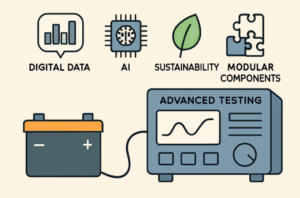
The spectrum of battery-powered products, ranging from smartphones to solar farms, demands testing platforms that are equally versatile. The latest modular and scalable test systems allow customization for different chemistries, sizes, and discharge rates, adapting seamlessly from research labs to high-volume production lines. Automation, driven by artificial intelligence, ensures consistency, accuracy, and rapid transitions between test scenarios, removing variability and human error from the process. These advancements create a more flexible, responsive, and resilient battery testing infrastructure, paving the way for the next generation of reliable energy solutions. By integrating real-time data analytics, engineers can identify performance trends and potential failures before they occur. Cloud-connected platforms enable remote monitoring and collaborative testing across multiple sites, accelerating innovation cycles. Ultimately, these systems support safer, longer-lasting batteries while reducing development costs and time to market.
Conclusion
The future of energy storage hinges on the ability to deliver efficient, reliable, and sustainable battery technologies. By embracing innovative testing solutions—ranging from EIS and machine learning to digital twins and modular platforms—the industry is setting higher standards for performance and longevity. These approaches are not only making batteries better; they are establishing best practices for accelerated innovation and responsible stewardship in the clean energy era.